Noun (Basic ㊦ 236)
An already given situation or condition remains unaltered.
Equivalent: As it is; unchanged; undisturbed; leave as is; remain
| (i) Vinformal past | まま | |
| (電気を)つけたまま | Leaving (the light) on | |
| (ii) Adjective い | まま | |
| 大きいまま | As something is big | |
| (iii) {Adjective な stem/ Noun の} | まま | |
| 不便なまま | Leaving something is inconvenient | |
| 昔のまま | Leaving something as it was |
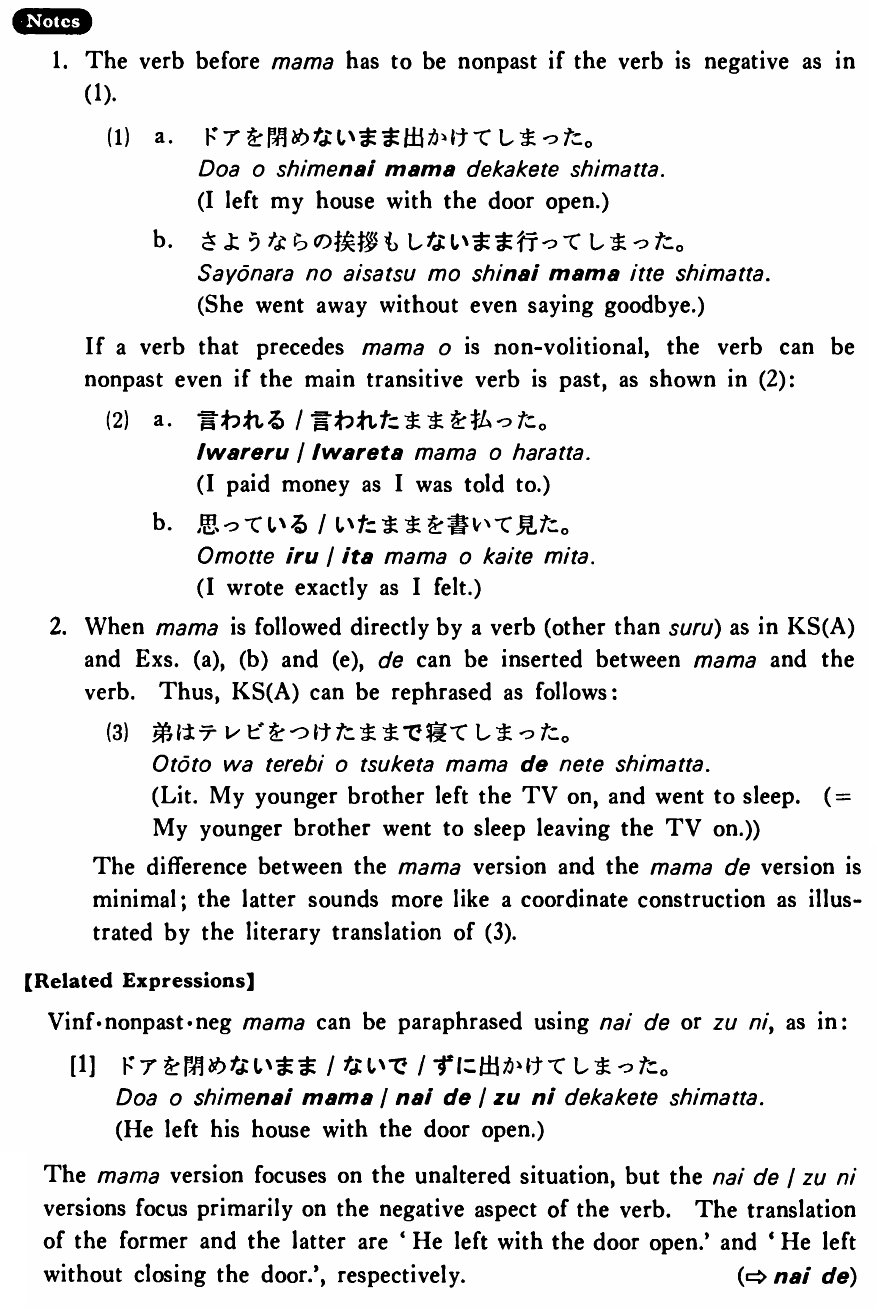
1. The verb before まま has to be nonpast if the verb is negative as in (1).
If a verb that precedes ままを is non-vontional, the verb can be nonpast even if the main transitive verb is past, as shown in (2):
2. When まま is followed directly by a verb (other than する) as in Key Sentence (A) and Example (a), (b) and (e), で can be inserted between まま and the verb. Thus, Key Sentence (A) can be rephrased as follows:
The difference between the まま version and the ままで version is minimal; the latter sounds more like a coordinate construction as illustrated by the literary translation of (3).
【Related Expressions】
Verb informal nonpast negative まま can be paraphrased using ないで or ずに, as in:
[1]
The まま version focuses on the unaltered situation, but the ないで/ずに versions focus primarily on the negative aspect of the verb. The translation of the former and the latter are 'He left with the door open' and 'He left without closing the door.', respectively.
(⇨ ないで)